Feet first

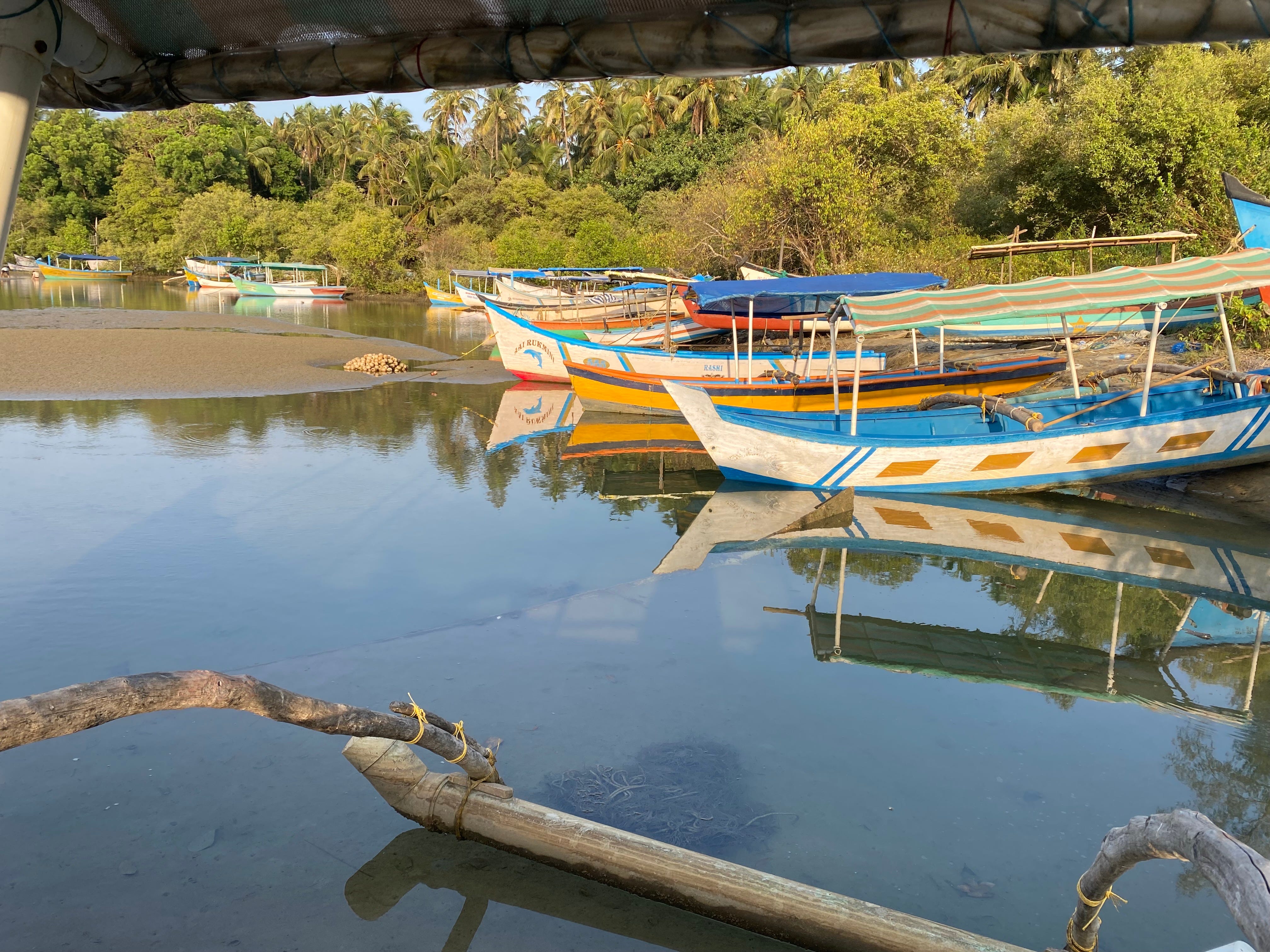
The first thing that arrives in Palolem is not the sea, but a feeling; it is that faint, stubborn sense that something quieter once lived here. It lingers in the early morning, before the cafés lift their shutters, before music drowns out the day, before menus begin to speak in too many accents. If you wake early enough, you can still find it: a village not yet crowded out by its own popularity.
I began, as I often do, with a walk.
Why is walking so rewarding every single time? It seems almost too simple to ask, and yet the answer returns differently on different mornings. A walk has a way of getting you closer to yourself in ways that feel both subtle and immediate. One foot in front of the other—you learn that for the first time as a child, and then there is no turning back. What becomes second nature, though, can also become invisible. We forget the miracle of it, the quiet intelligence of the body that carries us forward without instruction.
But here, on this beach, walking refuses to remain invisible.
I slipped off my sandals and let my feet meet the ground directly. Walking barefeet is perhaps the simplest, most elegant way to be. The entire body awakens through the feet. The sensation rises almost instantly—from the soles, through the calves, into the hands, and then upward along the spine. There is a clarity to it, a kind of unmediated contact with the world. It is unlike the dull insulation of footwear, where the ground is always one step removed. Here, nothing is filtered.
And then there is sand.
Take that same act of walking—bare, attentive—and place it on soft white sand. Suddenly, the muscles come alive in a different way. Each step sinks slightly, asking for effort, for balance, for adjustment. The calves tighten and release; the arches of the feet stretch and respond; the spine finds its alignment again and again. Walking on sand is not passive—it is a conversation between body and earth. You cannot rush through it without feeling the cost. And yet, that cost is also a gift. It brings you fully into the present moment.
The sand was still cool from the night, holding the memory of the receding tide. It bore only the lightest traces of activity—the delicate scribbles of crabs, the long dragged lines of fishing nets pulled in at dawn. As I walked, my feet read these textures like a quiet script. A firmer stretch near the waterline, a softer drift further up, an occasional shell pressing its brief signature into the skin. This is a kind of knowing that belongs entirely to the body.
Out at sea, a few boats hovered in the pale blue distance, their silhouettes steady against the shifting water. Closer to shore, the morning’s labour had already begun to reveal itself. Nets lay open across the sand—wide, breathing surfaces still damp with salt and effort. Walking alongside them, I noticed how they seemed to extend the movement of the sea onto land, as though the waves had left behind a trace of their own motion.
A group of women sat and stood around the catch, their movements swift, practiced, and purposeful. There was no spectacle here—it was so routine and necessary that they refused to even indulge me in a stray conversation. They sorted squid, crabs, and small mackerel into came baskets, their hands moving through the nets, separating, selecting, arranging. The fish caught the early light in quick flashes of silver and grey. Water pooled briefly beneath them before disappearing into the sand.
A little distance away, the men worked just as quickly, but with a different urgency. What would not be taken to sell was gathered and packed into smaller portions—efficient, almost instinctive decisions made in seconds. These packets, I was told, would make their way home, to be cooked over lunch. There was something deeply grounding in this gesture: the sea translated directly into the day’s meal, the morning’s labour carrying itself forward into the intimacy of the household.
These were not idle moments. This was the beginning of the day’s work—the preparation before the walk inland, where the catch would be sold, negotiated, carried into kitchens of different homes. Watching them, I sensed a different rhythm from the one often associated with the beach. This was not leisure; it was livelihood. And yet, there was a quiet grace in the way it unfolded—unhurried, efficient, deeply familiar.
I continued walking.
It struck me then how walking holds together two movements at once: an inward turning and an outward noticing. As my body adjusted to the softness of the sand, my mind began to settle. The rhythm of my steps found its own pace—not hurried, not aimless, but attentive. With each step, the world seemed to come closer, not because I was moving toward it, but because I was finally present enough to receive it.
The boats rested in a long, uneven line further along the shore. Some had been pulled high onto the sand, their hulls leaning into one another as if sharing the weight of the night’s work. Others lingered at the water’s edge, tethered but restless. Nets were draped over them to dry, transforming each boat into textured forms—part vessel, part sculpture. Names painted along their sides—faded, peeling—hinted at stories: invocations, memories, perhaps even quiet acts of faith.
Walking past them, I felt again the subtle labour of the body. Sand does not allow you to forget your weight. Each step asks for attention. Each shift in balance reminds you that walking is not simply a means of getting somewhere, but an act in itself. There is a kind of humility in it.
And then there was the tide. And as the tide receded further, another world began to appear.
What had been covered just hours ago now revealed itself in small, insistent ways. Tiny fiddler crabs emerged from their burrows, their singular oversized claws raised and waving, as though calling out, signalling to one another, or perhaps simply announcing their presence to the morning. Their movements were quick, almost nervous, disappearing the moment a shadow passed too close.
Nearby, a few ibis birds moved with their long beaks probing the wet sand for food left behind by the retreating sea. A solitary heron stood still for long stretches, then struck suddenly, its patience collapsing into action in a single fluid motion. These were not dramatic scenes, but they carried their own intensity—a different kind of labour, one that mirrored the human activity unfolding just a few metres away.
Closer to the rocks, clusters of barnacles clung stubbornly to exposed surfaces, their rough textures catching the light. They felt ancient, almost indifferent to the rhythms that animated everything else. The retreating tide had not just widened the beach; it had revealed a layered ecology, a set of lives that exist in the narrow margins between water and land.
In the morning, the sea feels almost hesitant, as if it has stepped back just enough to let the land speak. The tide recedes, revealing what the night has carried in—shells, seaweed, driftwood, and the quiet evidence of labour. The beach widens, offering space not just for movement but for attention. Walking in this hour feels like entering a conversation that is still unfolding.
But by evening, the tide returns differently. It rises fuller, more insistent, reclaiming what was briefly given away. The marks of the morning—footprints, net lines, the delicate scripts of crabs—are slowly erased. The same stretch of sand becomes something else entirely. Where the morning invites solitude, the evening gathers people. Where the morning reveals, the evening conceals. The sea grows darker, more assertive; the shoreline narrows; the day’s quiet textures are replaced by a louder, more crowded presence.
As I turned back, retracing my steps, I noticed how quickly the sand had begun to warm. A few early visitors had appeared, their footprints crossing over mine, rewriting the path I had just taken. Walking, I realised, is also about this—about leaving something that will not last, about participating in a landscape that is always in the process of being remade.
This walk, though, feels like a beginning.
There is another part of this village I want to find—away from the immediate pull of the beach. I’ve read of a chapel, over a hundred years old, standing quietly within the folds of this place, holding a different kind of time. If the beach gathers the labour of the present—the nets, the boats, the morning catch—then perhaps that space holds something else: memory, devotion, continuity.
Tomorrow, I will walk there.